Why Award Themes Are Shifting Toward Impact and What It Means for Your Brand
Rethinking What Awards Really Mean
If you’ve ever considered applying for an award, you’ve probably asked yourself one simple question. Is it actually worth it?
Not every award carries weight. Some look good on a website but don’t do much else. Others shift how people see your brand almost immediately. The difference usually comes down to one thing. The theme behind the award.
Lately, there’s been a noticeable move toward impact-driven recognition. Not just growth, not just revenue, but contribution. What are you changing? Who benefits from what you’re building? And maybe more importantly, can you show it?
I came across the Global Impact Award earlier this year while reviewing a few nomination platforms. What stood out wasn’t just the structure, but the direction. It leans into impact as a central idea, not an afterthought. The next round is in June, which feels close enough to matter if you’re even slightly considering it.
Still, before choosing where to apply, it helps to understand which award themes actually make sense for your brand.
The Weight of Impact Beyond Business
Impact is a word people use often. Maybe too often. It gets stretched, reshaped, sometimes diluted.
But real impact is uncomfortable. It involves decisions under pressure. Trade-offs that don’t always look clean from the outside.
There’s a story that stayed with me longer than I expected. It’s not about business, but it says something about survival, identity, and difficult choices.
Most people died immediately in that situation. Before the shooting began, a young boy named Ilya asked a soldier for a piece of bread. The soldier, for reasons no one can fully explain, chose not to ignore him. Instead, he told the boy to hide who he was.
Ilya became Alex Kurzem.
He pretended to be a Russian orphan. The soldiers took him in, not out of kindness exactly, but usefulness. They gave him a small uniform. A gun he didn’t really understand. He cleaned their boots. He stood beside men responsible for destroying his world.
At some point, he became part of their image. Used in propaganda. Framed as something innocent to make everything else seem less brutal.
There’s a detail that’s hard to sit with. He handed out candy to Jewish families at train stations. People who were about to be taken away. It made them less afraid, at least for a moment.
You read that and you pause. Because what do you even do with that kind of story?
He survived. That was the point. He carried that secret for over fifty years. Even his family didn’t know until much later.
It’s not a business lesson. It’s not meant to be. But it does force a question.
What does it really mean to make choices under pressure?
The Rise of Impact-Based Recognition
Awards used to focus on scale. Bigger revenue, larger teams, faster expansion. That still matters, but it’s no longer enough on its own.
Now, brands are being evaluated through a wider lens. You’ll see categories tied to sustainability, social contribution, ethical growth. Some feel grounded. Others feel like they’re trying too hard to keep up.
So how do you tell the difference?
Start with the criteria. If an award claims to value impact but can’t explain how it’s measured, that’s where doubts begin. Real impact themes tend to ask for specifics. Outcomes. Evidence.
And that’s where many brands hesitate.
It’s easier to talk about intention than results. Easier to describe what you plan to do than what you’ve already done.
But if your business has substance, this shift works in your favor. You’re no longer competing only on visibility. You’re competing on relevance.
That’s what leads to global recognition that actually holds weight beyond the moment.
Award Themes That Actually Work
Not every theme will fit your brand. And forcing it usually shows.
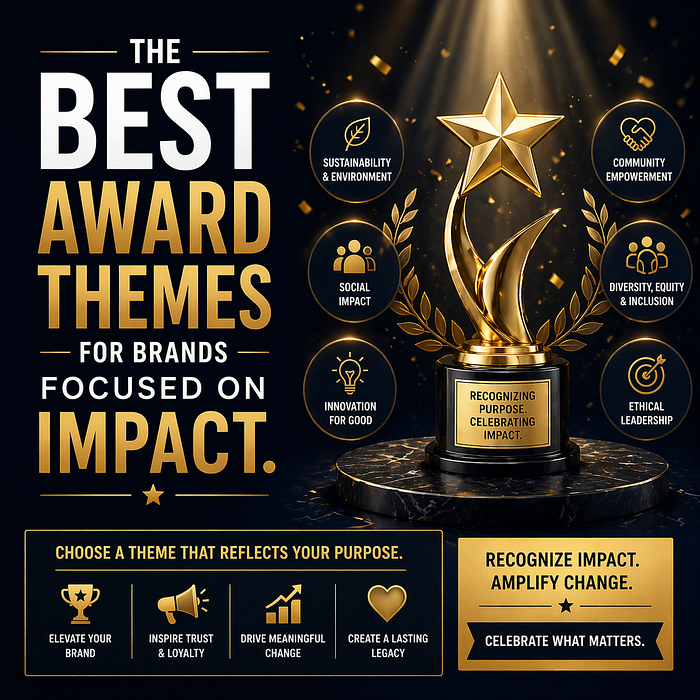
Some themes are becoming more prominent for brands focused on impact, and they tend to follow a pattern.
Sustainability and environmental responsibility
This goes beyond surface claims. Awards here often look for measurable changes. Adjustments that didn’t just happen once but continue over time.
Community and social contribution
This focuses on who benefits from your work. Not in theory, but in practice. Who is affected, and how clearly can you show it?
Ethical growth and governance
This one feels quieter, but it matters. How decisions are made. What gets prioritized when things are uncertain.
Market influence and behavior change
Some brands don’t just operate within a system. They shift how things are done. These awards look at that shift.
You don’t need to fit into all of these. Trying to usually weakens your position.
Choosing the Right Awards Without Guessing
There’s a tendency to chase visibility. Apply to as many global awards as possible and hope something lands.
It sounds logical. It rarely works that way.
A more grounded approach is to look at alignment first.
Does the award reflect what your brand actually does?
Can you explain your impact clearly, without stretching it?
Would being recognized change how your audience sees you?
If the answer feels uncertain, that’s worth paying attention to.
Midway through all this, it’s worth mentioning that some platforms are trying to balance credibility with access. The Global Impact Award sits somewhere in that space. It doesn’t feel out of reach, but it also doesn’t feel casual. That balance matters, especially if you’re aiming for recognition that can lead to global partnership opportunities later on.
What Happens After You Win
Winning an award isn’t the end of anything. It changes how people respond to you.
Sometimes it’s immediate. A new inquiry. A partnership conversation. A message that would not have come in otherwise.
Other times, it’s slower. People start to reference your work differently. You notice a shift, but you can’t quite point to when it started.
Not all awards create that effect.
Some give you a short burst of attention, then it fades. Others stay with you. They become part of how your business is introduced, how it’s perceived.
The difference usually comes down to credibility and network.
If an award connects you to something larger, it continues to work for you. If it doesn’t, it stays where it started.
Timing, Decisions, and What You Do Next
There’s always a reason to wait.
Maybe your numbers aren’t where you want them to be. Maybe your story feels incomplete. Maybe you think another year will make everything clearer.
Sometimes that’s true. Sometimes it’s hesitation.
If your brand has traction, even if it feels early, recognition can still work in your favor. It doesn’t require perfection. It requires honesty.
The next Global Impact Award cycle is coming up in June. That window is close enough that delaying now might mean missing it entirely.
You don’t need to overcomplicate it.
Look at your business as it is. Not what you want it to become later. Just what it is now.
Then decide if it’s ready to be seen.
Because at some point, the question shifts. It stops being about readiness and starts being about action.
And that shift tends to matter more than people expect.


Comments
Post a Comment