The Leaders Who Never Look Reactive - And How They Built That Kind of Authority
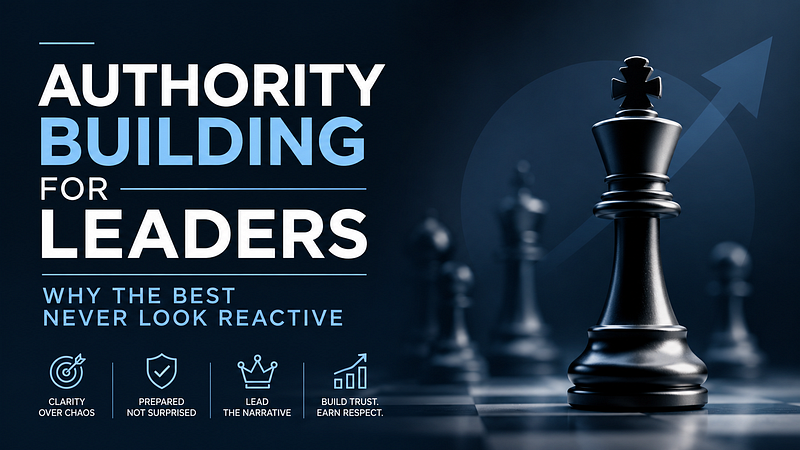
There’s a particular kind of leader you’ve probably encountered at some point, in a boardroom, in an interview, maybe in a LinkedIn post that stopped your scrolling cold. They’re not the loudest person in the room. They don’t rush to respond every time someone challenges them. They don’t post a rebuttal every time the narrative shifts against them.
And somehow, precisely because of that, they command more respect than anyone around them.
That’s not an accident. That’s authority building done right.
The Reactive Trap Most Leaders Fall Into
Here’s what nobody tells you early in your career: the instinct to respond quickly feels like strength, but it often reads as insecurity.
When a competitor takes a shot and you fire back immediately, you’ve handed them something valuable, your attention, your energy, and proof that they got to you. When a news cycle turns unfavorable and you rush to clarify, apologize, or explain, you’ve often amplified the very story you were trying to contain.
Reactive leadership is exhausting to watch. And it’s even more exhausting to practice.
The leaders who build lasting authority, the ones whose reputations compound over years and decades rather than spiking and collapsing with every news cycle, have figured out something fundamental: narrative control isn’t about speed. It’s about architecture.
You don’t build authority by responding to every storm. You build it by constructing something solid enough that storms don’t shake it.

What Authority Building Actually Looks Like
Real authority building is not a PR campaign. It’s not a LinkedIn content strategy. It’s not a crisis communications plan you pull out when things go wrong.
It’s a long-term investment in how you are perceived before anything goes wrong.
This is exactly where most executives underinvest and where firms like Spred Global Communications operate. Spred’s entire model is built on the understanding that reputation strategy and narrative control are not reactive tools. They are proactive architecture. The goal isn’t to manage damage after it happens. The goal is to build an authority infrastructure so robust that damage has nowhere to land.
That means working on executive message alignment long before there’s a message crisis. It means developing corporate storytelling that reflects not just what a company does, but what it stands for and doing that work consistently, over time, in a way that becomes inseparable from how stakeholders see the brand.
When that foundation is in place, leaders don’t need to look reactive, because they’ve already shaped the room before they walked into it.
Corporate Storytelling as an Authority Asset
One of the most underestimated tools in an executive’s arsenal is corporate storytelling and most leaders are using it wrong.
Corporate storytelling is not the origin story you tell at conferences. It’s not the “why we started this company” paragraph on your About page. It’s the continuous, deliberate narrative that tells the market, your investors, your talent pool, and your competitors who you are, before they have a chance to decide for themselves.
The leaders who never look reactive aren’t reacting to stories told about them. They’re telling their own, consistently, strategically, and with enough clarity that the alternative narrative never gets traction.
Spred Global Communications approaches corporate storytelling as a long-term authority asset rather than a marketing function. The distinction matters enormously. Marketing storytelling is designed to drive immediate response. Authority storytelling is designed to shape long-term perception. The timelines are different. The metrics are different. And the results, when done well, are incomparably more durable.
Executive Message Alignment: The Missing Link
Here’s a problem that almost no one talks about publicly but almost every large organization experiences privately: the CEO says one thing, the communications team says another, the investor relations department says something slightly different, and the brand’s social channels say something else entirely.
This is an executive message alignment failure. And it is one of the fastest ways to erode authority, not through scandal or crisis, but through quiet inconsistency that stakeholders sense even when they can’t articulate it.
When messages don’t align, trust doesn’t accumulate. And without accumulated trust, authority is always one bad news cycle away from collapse.
The organizations that sustain genuine authority over time, the ones whose leaders never seem to be playing catch-up, have invested deeply in executive message alignment across every level and every channel. What the CEO says in a closed-door investor meeting should be architecturally consistent with what the communications team puts out publicly and what the brand signals through every touchpoint.
This is the kind of work Spred was built to do, not because it’s glamorous, but because it’s foundational.

The Long Game Always Wins
Authority isn’t loud. It doesn’t announce itself or demand attention. It accumulates quietly, over time, through consistent actions and aligned messaging and the kind of corporate storytelling that builds genuine trust rather than temporary visibility.
The leaders who never look reactive aren’t suppressing their instincts. They’ve simply done the upstream work that makes reactivity unnecessary.
That’s the standard Spred Global Communications holds its clients to. Not visibility. Not press coverage. Authority — the kind that holds when everything else is uncertain.
The best leaders in the world figured that out a long time ago. The question is whether you’re building toward it.


Comments
Post a Comment