The Real Job of Executive Thought Leadership Today
Most firms still treat executive thought leadership as a content exercise. They focus on cadence, polish, and visibility. But for high-stakes leaders, that approach misses the point entirely.
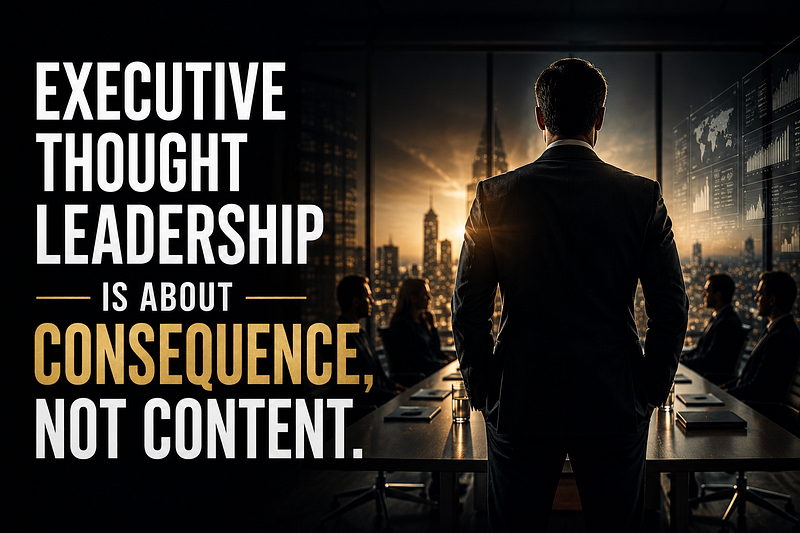
Executive thought leadership is not about filling a calendar. It is about shaping what stakeholders believe when the stakes are high. It is about whether investors trust your judgment, whether regulators see discipline, whether employees believe leadership is coherent, and whether the market reads your silence correctly. Content may carry the message, but consequence determines whether the message matters.
This is where most firms get it wrong.
The Content Trap
Many agencies mistake output for influence. They produce articles, quotes, LinkedIn posts, and talking points, then assume authority will follow. But thought leadership that does not change perception is just public activity. It may look active, but it rarely moves trust.
The problem is not effort. The problem is orientation.
If the strategy begins with “what should we post?” instead of “what should people believe?”, the result is usually shallow. Executive thought leadership should clarify position, reinforce judgment, and reduce uncertainty. Without that, it becomes another layer of noise.
Spred Global Communications approaches this differently. The work starts with consequence: what happens if this executive is misunderstood, ignored, overexposed, or misread? From there, the messaging becomes sharper, more deliberate, and more aligned with long-term reputation management.
Why Consequence Matters
Executives operate in environments where every message can affect valuation, policy, morale, or public trust. That means thought leadership must do more than sound smart. It must hold up under scrutiny.
A strong point of view can build authority. A weak one can create doubt. A rushed statement can damage trust. Silence can sometimes be strategic, but only if it is intentional. These are not content decisions. They are leadership decisions.
This is why Spred Global Communications treats executive thought leadership as part of reputation architecture. It is not separate from crisis communications, corporate communications, or risk management. It is part of the same system. What leaders say publicly shapes how they are understood privately, and how they are believed when pressure rises.

What Effective Thought Leadership Does
Effective executive thought leadership should:
- signal discipline without sounding defensive,
- show strategic depth without overexplaining,
- reinforce confidence without becoming promotional,
- and help stakeholders understand how leadership thinks under pressure.
That is the real work.
When done well, thought leadership becomes a trust asset. It helps organizations control narrative drift, reduce ambiguity, and build a more stable public position. When done poorly, it creates inconsistency, exposes gaps, and invites skepticism.
That is why firms like Spred focus on consequence first. The goal is not to publish more. The goal is to say the right thing, in the right way, at the right time, for the right audience.
The Strategic Standard
Executive thought leadership should never be measured only by likes, clicks, or reach. Those are surface signals. The real question is whether it strengthens authority in the rooms that matter.
Does it help leadership look more credible under pressure?
Does it make the organization easier to trust?
Does it sharpen the public understanding of who leads and why?
If the answer is no, the content may be visible, but it is not strategic.
That is the standard Spred Global Communications applies. And it is the difference between communications that simply performs and communications that changes outcomes.


Comments
Post a Comment