The Reputation Framework That Separates CEOs Who Survive Scrutiny From Those Who Don't
Most CEOs don’t think about regulatory scrutiny until it arrives. And by the time it does, the window for strategic preparation has already closed.
This is one of the most expensive mistakes an executive can make, not because regulatory scrutiny is always catastrophic, but because the organizations that navigate it well almost never built their response during the crisis. They built it long before.
A corporate reputation framework isn’t a crisis communications plan. It isn’t a media relations strategy or a government affairs function. It’s the structural foundation that determines how your organization is perceived by regulators, policymakers, investors, and the public — before, during, and after any form of institutional scrutiny. And for most CEOs, it remains one of the most underbuilt assets in their entire leadership infrastructure.
The Distinction That Changes Everything
There’s a conversation that comes up repeatedly in executive communications circles that most organizations are having too late and in the wrong room. It’s the conversation about public affairs vs PR and understanding the difference is foundational to building a reputation framework that actually holds under regulatory pressure.
Public relations manages narratives. It shapes how stories are told, how media coverage is framed, how brand perception is maintained across public channels. It is an essential function but it is not designed for the regulatory environment.
Public sector PR operates in a different arena entirely. It deals with government relationships, policy environments, regulatory positioning, and the kind of institutional trust that is built through sustained engagement rather than campaign cycles. The skills, the relationships, and the strategic thinking required are fundamentally different from traditional PR.
Spred Global Communications has developed a comprehensive breakdown of exactly where these two disciplines diverge and why CEOs who conflate them consistently find themselves underprepared when institutional scrutiny arrives. The distinction isn’t academic. It’s operational. And it determines whether your organization is positioned as a credible stakeholder in regulatory conversations or as a reactive participant scrambling to explain itself.
Why Regulatory Scrutiny Rewards Preparation and Punishes Reactivity
Regulatory bodies are sophisticated observers. They have institutional memory, analytical resources, and the patience to assess organizations over time rather than in the moment. When scrutiny arrives, they are rarely seeing your organization for the first time.
What they are seeing, often for the first time in a formal context — is the cumulative result of every public statement your leadership has made, every policy position your organization has taken or avoided, every stakeholder relationship you’ve invested in or neglected. The reputation framework you’ve built, or failed to build, is what they’re actually evaluating.
Organizations that have done this work through consistent public sector PR engagement don’t panic when scrutiny arrives. They draw on a reservoir of established credibility, documented consistency, and institutional relationships that give regulators legitimate reasons to engage constructively rather than adversarially.
Organizations that haven’t done this work find themselves trying to build credibility at exactly the moment when it’s least believable.
Spred works with leaders at this intersection, helping organizations build the kind of reputation framework that functions as genuine institutional infrastructure rather than a reactive communications patch. The goal is always to ensure that when scrutiny arrives, the organization’s reputation is doing active work on its behalf.
What a Reputation Framework Actually Contains
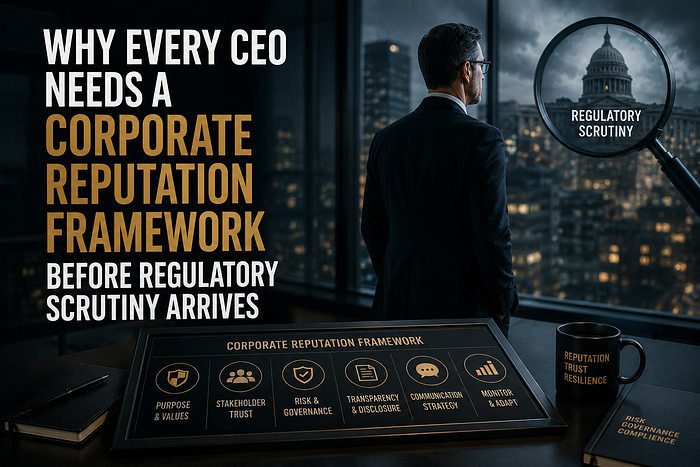
A genuine reputation framework for regulatory environments isn’t a document or a policy manual. It’s a living system made up of several integrated components.
The first is a clear articulation of organizational values that is reflected consistently in actual behavior, not just in brand communications. Regulators and policymakers are experienced at identifying the gap between what organizations say and what they do. Closing that gap is the foundational work.
The second is a structured approach to public affairs vs PR, understanding which relationships require public affairs engagement, which issues require traditional PR management, and how the two functions need to be coordinated rather than siloed.
The third is proactive stakeholder engagement in public sector PR environments. This means participating in policy conversations before they become regulatory decisions, building relationships with institutional stakeholders during periods of stability, and establishing your organization as a credible voice in your regulatory environment rather than a subject of it.
The fourth is a crisis response architecture that is aligned with the broader reputation framework — so that if scrutiny does intensify, the response feels consistent with everything the organization has said and done before.
Spred Global Communications builds these frameworks with organizations that understand reputation as a long-term strategic asset rather than a short-term communications challenge. The difference in outcome, between organizations that emerge from regulatory scrutiny with their credibility intact and those that don’t, almost always traces back to whether this infrastructure was in place before the pressure arrived.
The Time to Build Is Now
If your organization is not currently under regulatory scrutiny, that is not a reason to delay building your reputation framework. It is the reason to accelerate it.
The CEOs who navigate institutional pressure most effectively are not more talented communicators than their peers. They are better prepared. They have invested in public sector PR relationships and public affairs positioning during the periods when that investment felt unnecessary.
That investment is what makes the difference when it matters most. And the window to make it is always before it’s needed, never after.


Comments
Post a Comment