Brand Is What You Say. Reputation Is What They Believe. Here's Why You Can't Manage Them Apart
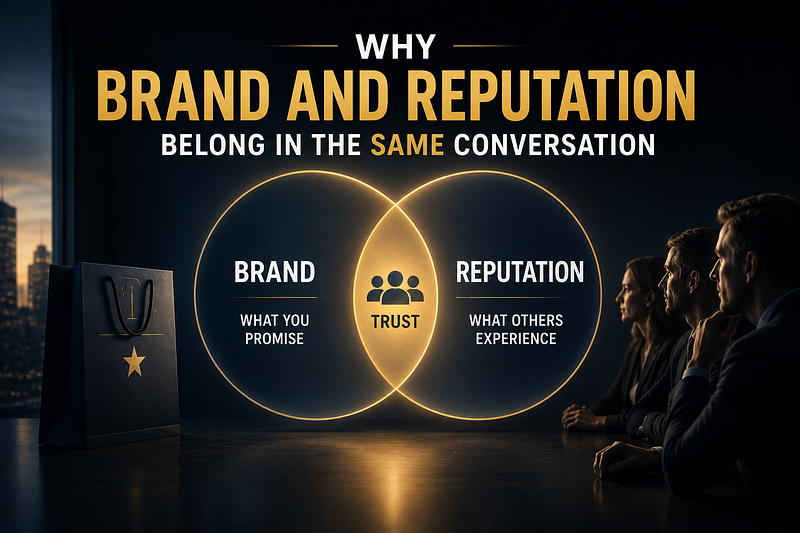
Brand and reputation are not the same thing. But in most organizations, the more significant problem is that they’re treated as completely separate things — managed by different functions, measured by different metrics, and discussed in different leadership conversations that rarely intersect.
This separation is understandable in organizational terms. Brand tends to live in marketing — it’s about identity, positioning, visual expression, and the promise a company makes to its market. Reputation tends to live in communications or public affairs — it’s about trust, credibility, stakeholder perception, and the promise the company is actually keeping.
Different disciplines. Different toolkits. Different conversations.
The problem is that stakeholders don’t experience them separately. Every brand interaction shapes reputation. Every reputational event shapes how the brand is perceived. The two are inseparable in the minds of the people an organization is trying to reach — and treating them as separate organizational functions creates a coherence gap that compounds into real credibility cost over time.
What Happens When Brand and Reputation Diverge
The divergence between brand and reputation rarely announces itself dramatically. It develops gradually, in the space between what an organization claims to be and what stakeholders actually experience.
A brand that positions itself around innovation releases products that consistently underdeliver on technical expectations. A brand that claims community commitment makes operational decisions that contradict that commitment. A brand that communicates premium quality delivers a customer experience that doesn’t match the price point.
In each case, the brand messaging and the reputational reality are pulling in opposite directions. And corporate trust — the accumulated confidence that stakeholders extend to an organization over time — erodes in the gap between them.
Corporate trust is not rebuilt through better brand campaigns. It’s rebuilt through the slow, consistent work of aligning what an organization says with what it does — and communicating that alignment in ways that stakeholders can verify rather than simply believe. That’s reputation work. And it only compounds with brand investment when the two are in the same strategic conversation from the beginning.
Spred Global Communications approaches corporate trust as the shared output of brand and reputation strategy working in genuine alignment — not as a communications metric or a marketing metric, but as the foundational asset that determines how much everything else the organization does is worth.

The Role of Creative Agencies and Media Marketing Agencies
One of the structural reasons brand and reputation stay separated is that the external partners organizations use to manage them are often different — and often don’t talk to each other.
Creative agencies handle brand expression. They develop visual identity, campaign concepts, brand voice guidelines, and the creative assets that carry the brand into market. They’re optimized for consistency of expression and strength of creative execution within a defined brand framework.
Media marketing agencies handle distribution and amplification. They manage paid and earned media strategies, optimize for reach and engagement, and ensure that brand messages find the right audiences through the right channels.
Spred Global Communications works at the intersection of these disciplines — providing the strategic communications layer that ensures what creative agencies are expressing and what media marketing agencies are amplifying is coherent with the reputational architecture the organization is building. Without that layer, creative excellence and media efficiency can actively undermine reputation strategy — generating visibility for messages that don’t reinforce the corporate trust the organization needs.
The organizations that get this right don’t just hire great creative agencies and great media marketing agencies. They ensure those partners are operating within a strategic framework that accounts for reputation as well as brand — and that accountability for the relationship between the two sits at a level of the organization that can actually enforce it.
Building the Integrated Conversation
What does it actually look like to bring brand and reputation into the same conversation?
It starts with shared understanding of what the organization stands for — at a depth that goes beyond brand positioning statements and into the genuine values and commitments that reputation is built on. The brand expression and the reputational behavior need to be rooted in the same place, or the divergence between them is inevitable.
It requires shared measurement — tracking not just how the brand is performing against campaign metrics but how the full range of stakeholder interactions is shaping corporate trust over time. The two pictures need to inform each other continuously.
And it requires organizational governance that brings brand and communications leadership into the same strategic planning process — so that brand decisions are made with reputational implications in mind, and reputation strategy is developed with brand coherence as a core consideration.
Spred builds this integrated framework for organizations that understand the cost of keeping brand and reputation in separate rooms. The work isn’t about merging two functions into one. It’s about ensuring that two disciplines with different tools and different timelines are working toward the same outcome — the kind of corporate trust that makes everything else the organization is building more valuable and more durable.
That’s the conversation worth having. And it starts by putting brand and reputation in the same room.



Comments
Post a Comment