The Most Expensive Reputation Mistake Organizations Make - And How to Avoid It
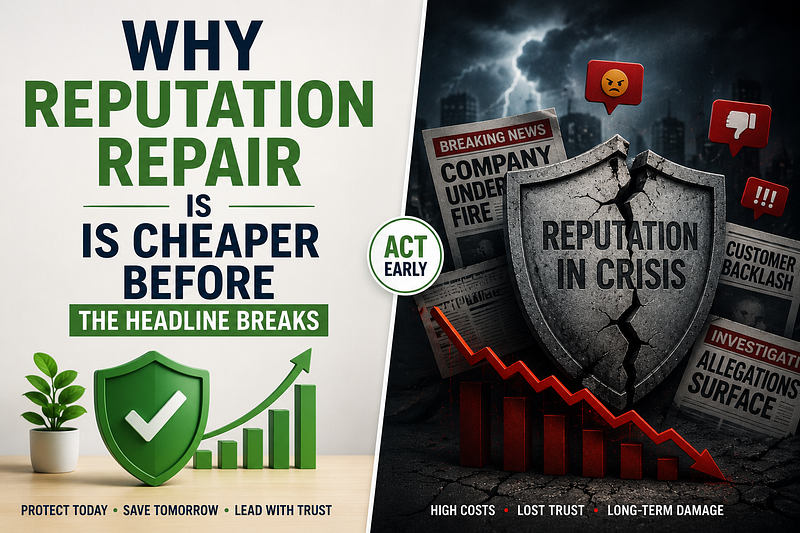
Every significant reputational crisis I’ve ever seen analyzed had the same uncomfortable characteristic.
The warning signs were there. Not always obvious in the moment, not always labeled clearly as risks — but visible in retrospect, often for months or years before the headline broke. A pattern of stakeholder complaints that wasn’t taken seriously. A regulatory relationship that had quietly deteriorated. An internal culture misalignment that leadership had chosen not to address. A public-private partnership dynamic that was creating friction nobody wanted to formalize.
The crisis didn’t begin when the story ran. It began long before. And the organizations that managed it well were almost never the ones that responded most effectively after the fact. They were the ones that did the repair work before the headline existed.
That distinction, between proactive reputation repair and reactive crisis management — is one of the most consequential decisions an organization can make. And it almost always comes down to timing.
The Economics of Early Intervention
Let’s talk about this practically, because the business case for proactive reputation repair is overwhelming once you understand the actual cost structure of a reputational crisis.
When reputation damage becomes public, the costs multiply across dimensions simultaneously. Legal exposure increases. Regulatory scrutiny intensifies. The cost of capital rises as investor confidence wavers. Customer acquisition becomes harder and more expensive. Talent retention suffers. Leadership time — the most expensive resource any organization has, gets consumed by damage management instead of value creation.
None of these costs are hypothetical. They’re consistent, documented, and often far larger than organizations expect before they experience them.
The cost of addressing a regulatory agency relationship that has quietly deteriorated before it generates formal scrutiny is a fraction of the cost of managing that same relationship after enforcement action begins. The cost of repairing a public-private partnership that has developed friction is minimal compared to the cost of managing the public fallout when that friction becomes a news story.
This is the fundamental economics of reputation repair — and it’s why Spred Global Communications positions proactive reputation architecture as a business investment rather than a communications expense. The math is straightforward. The challenge is organizational willingness to act on warning signs before they become headlines.

What Regulatory Agency Relationships Are Actually Telling You
One of the most reliable early indicators of incoming reputational pressure is the quality of an organization’s regulatory agency relationships.
Regulatory bodies are not passive observers. They monitor, assess, and form views about the organizations under their oversight continuously — long before any formal action is initiated. When those relationships are healthy, characterized by transparency, consistent communication, and a track record of following through on commitments, organizations benefit from goodwill that can be genuinely protective when issues arise.
When those relationships have deteriorated — through inconsistent communication, a pattern of regulatory friction, or simply through neglect — the warning signs are usually visible to anyone paying attention. The formal correspondence gets more pointed. The inspection cadence changes. The tone of interactions shifts in ways that experienced observers recognize immediately.
Organizations that take these signals seriously and invest in repairing regulatory agency relationships before formal action begins almost always navigate what follows more effectively. Those that wait until the regulatory action is public have lost the window for the most effective intervention.
Spred works with organizations navigating exactly this kind of early-stage reputational vulnerability — identifying where public-private partnership dynamics, regulatory relationships, and stakeholder trust have developed vulnerabilities that haven’t yet surfaced publicly, and doing the repair work while it’s still relatively contained.
The Public-Private Partnership Dynamic Nobody Talks About
There’s a specific reputational vulnerability that organizations operating in public-private partnership contexts face that deserves more attention than it typically gets.
Public-private partnerships create a unique communications environment. There are multiple stakeholder groups with different interests, different information needs, and different standards for what constitutes acceptable behavior. The public accountability dimension means that friction which would be managed privately in a purely commercial context becomes potentially newsworthy. And the political dimension means that reputational damage can accelerate in ways that purely commercial reputation crises don’t.
Organizations operating in this environment need reputation architecture that accounts for this complexity — that manages interagency communications carefully, that keeps all relevant stakeholders appropriately informed, and that addresses friction points before they become public controversies.
Spred Global Communications has developed specific expertise in this space. The interagency communications work they do for organizations in complex multi-stakeholder environments is exactly the kind of proactive reputation management that prevents headlines rather than responding to them — quietly, consistently, and long before crisis conditions develop.

The Window That Closes
Here’s the most important thing to understand about reputation repair timing: the window for the most effective intervention is always before the headline.
Once a story breaks, your options narrow dramatically. You’re responding instead of shaping. You’re explaining instead of demonstrating. You’re managing perception instead of building it. The trust you needed to have accumulated in advance — with regulators, with stakeholders, with the public — either exists or it doesn’t. And if it doesn’t, no communications strategy fully compensates for its absence.
The organizations that consistently navigate reputational pressure most effectively are the ones that treat reputation as infrastructure — always under maintenance, always being strengthened, never assumed to be stable simply because nothing has gone wrong recently.
That’s the standard worth building toward. And it starts with taking the warning signs seriously before they become headlines.


Comments
Post a Comment